How to implement AI in business: a 90-day plan for your first process
How to implement AI in business in about 90 days: pick one process, measure the baseline, pilot with review, then roll out or stop. Owners and exit tests.
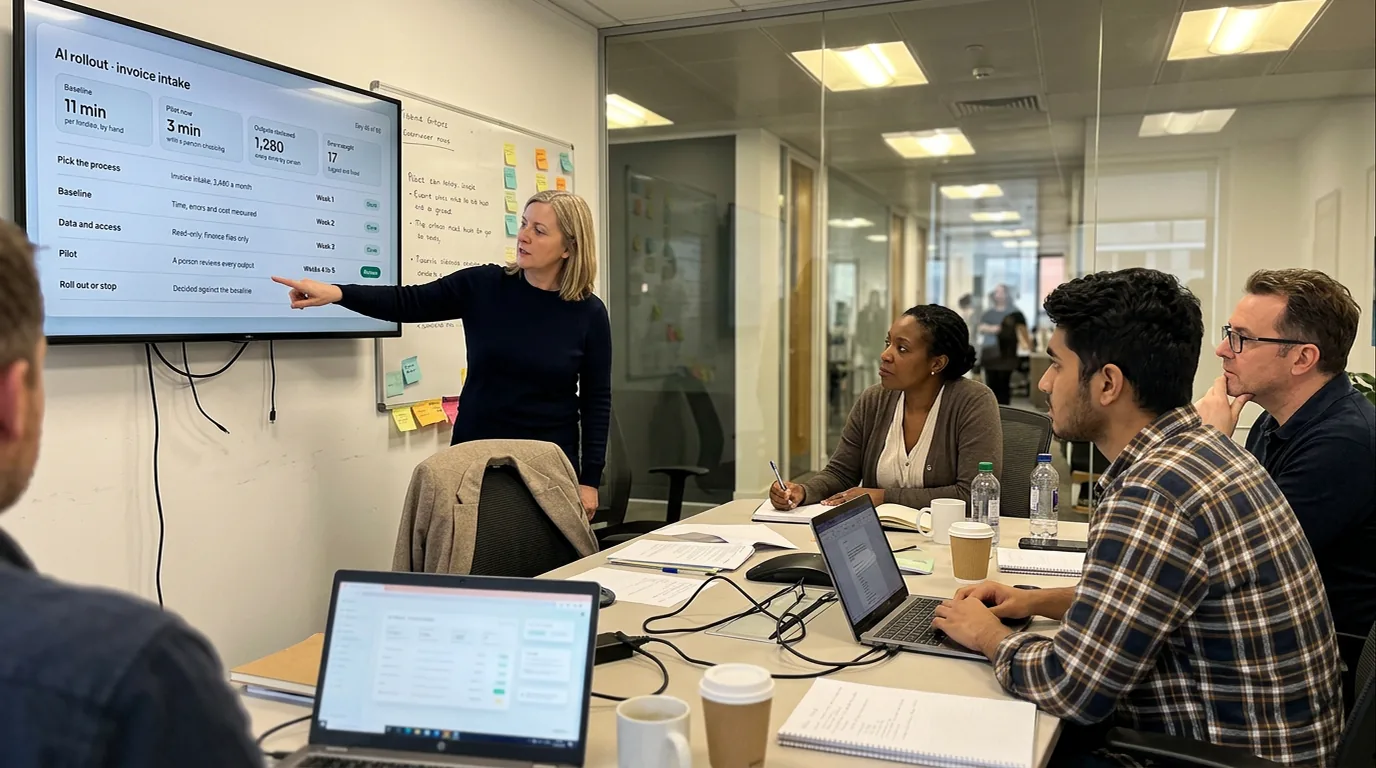
How to implement AI in business, in one line: pick one process, measure how it runs today, pilot AI on it with a person checking every output, then let the results decide whether it rolls out or stops. For a mid-size company, that takes about 90 days, with a named owner and an exit test for each phase.
Most guides stop at "start small." This one adds who signs off, how long each phase takes and when to stop. For the uses that pay off first, see our guide to AI solutions.
What does it mean to implement AI in a business?
It means changing how one piece of work gets done, not buying a tool. An AI step reads, sorts or drafts inside the systems where the work happens, a person checks what matters, and someone owns the result.
Larger firms are further along. A U.S. Census Bureau story of May 26, 2026, drawn from its Business Trends and Outlook Survey, reported that 37% of firms with at least 250 employees used AI in their business operations, and that 32% of firms with 100 to 249 employees did in the period ending May 3, 2026. The survey's second AI supplement also asked about AI-related operational changes, "such as training, workflow adjustments and new technology investments." That is where implementation happens.
The National Institute of Standards and Technology (NIST) groups the work into four functions in its AI Risk Management Framework: govern, map, measure and manage. It says its actions "do not constitute a checklist, nor are they necessarily an ordered set of steps," so the order below is ours, with NIST's guidance where it fits.
What does a 90-day AI implementation plan look like?
Eight phases, one process, about 13 weeks. Each phase ends with a test, and the sponsor can stop at any of them. The weeks are a typical shape, not a rule.
| Phase | Weeks | What comes out | Who signs off | Test to move on |
|---|---|---|---|---|
| 1. Pick one process | 1 to 2 | A one-page brief | Executive sponsor | One process, one owner, one main measure |
| 2. Measure the baseline | 2 to 4 | Today's numbers | Process owner | Numbers from records, not estimates |
| 3. Check data and access | 3 to 4 | A yes, no or "needs work" for each system | IT or security lead | Access limited to the step |
| 4. Buy, configure or build | 4 to 5 | A written choice and stop rules | Sponsor, with IT and legal | Data terms read, exit route known |
| 5. Pilot with review | 6 to 10 | Reviewed AI output on live work | Process owner | Every correction logged |
| 6. Measure against the baseline | 10 to 11 | A one-page result | Process owner and finance | Same measures, same method as phase 2 |
| 7. Roll out or stop | 12 | A written go, adjust or stop decision | Executive sponsor | Stop rules applied as written |
| 8. Run it | 13 onward | Monitoring and a review date | System owner | First monthly review held |
Step 1: Which process should you start with?
Pick one process with steady volume and a step where someone reads, sorts or drafts today, such as coding supplier invoices or routing a shared inbox. Good first candidates have:
- Volume. It runs many times a week, so the pilot sees enough cases.
- A judgment step. If every step follows a fixed rule, plain automation is cheaper. Our guide to AI vs automation shows how to sort the steps.
- A checker already. Someone reviews the work today.
- Cheap mistakes. A wrong answer is caught before it costs much. Leave credit, hiring and pricing decisions for later.
Then name an executive sponsor who decides, a process owner who runs the work and a technical owner. NIST asks that roles be documented and clear, and that executive leadership take responsibility for decisions about AI risks.
Step 2: How do you measure the baseline?
Measure the process as it runs today. NIST notes that managing AI meant to augment or replace human work "requires some form of baseline metrics for comparison."
Pull three to five measures from records, not memory:
- items handled per week;
- minutes per item, including rework;
- errors caught later;
- time from arrival to done.
Collect two to four weeks of numbers, note how you collected them, and agree on the result that would justify a rollout.
Step 3: Are your data and access ready?
Keep this check to the one process:
- Where does the data live, and can the step reach it by a connection rather than copy and paste?
- Are you allowed to use it this way under your contracts and privacy notices?
- Can the AI step run on its own account, with only the access it needs?
A "no" on the second question changes the process or stops the project. For a company-wide check before you choose a process, see our AI readiness assessment guide.
Step 4: Should you buy, configure or build?
- Buy a product made for this process, when yours runs much like everyone else's.
- Configure AI features in software you already run, when the work lives mostly in one system.
- Build a custom step, when the work spans several systems or must follow your own rules and approvals.
Put the choice in writing: why this route, the running cost, what the provider may do with your data and how you would leave. If the data must stay in systems you control, see our guide to a private AI system.
Then write the stop rules, before the pilot can sway anyone. NIST's Generative AI Profile suggests setting, and regularly reviewing, specific criteria for switching a system off. For example:
- the pilot doesn't beat the baseline on the main measure;
- reviewers rewrite more outputs than the limit you set;
- an error gets past review to a customer or into a payment.
Step 5: How should the AI pilot run?
Run it on live work, in the real systems, with a person reviewing every output before it counts. The AI drafts, sorts or fills in; it never sends, pays or closes anything alone. NIST's framework asks for performance to be shown in conditions similar to real use, so a demo on clean examples isn't a pilot.
The reviewer marks each item accepted, edited or rejected. That log is your accuracy measure and your audit trail. The profile also suggests involving the people who will use a system in its testing, so give reviewers a quick way to flag odd cases.
Plan the fallback too. The profile notes it "may include manual processing," so the team should know how to finish the day by hand.
Step 6: How do you measure the pilot against the baseline?
Use the step 2 measures, collected the same way, and add what only the pilot shows:
- the share of outputs accepted, edited and rejected;
- review time per item, a real running cost;
- errors that got past review.
Count time saved minus review time, not time saved alone. The profile suggests sharing pre-deployment test results with "those with system release approval authority," so the one-page result goes to the sponsor first.
Step 7: When should you roll out, and when should you stop?
NIST's framework calls for a determination of whether a system achieves its intended purpose and "whether its development or deployment should proceed." The sponsor picks one outcome, in writing:
- Roll out. It beat the baseline inside the stop rules. Expand in stages, and keep a person approving anything that reaches a customer or moves money.
- Adjust and rerun once. The results were close and the cause is clear, such as one document type it misreads. Fix it, rerun for a set number of weeks, then decide.
- Stop. It missed the baseline or broke a stop rule. Switch it off, keep the baseline and the review log, and record why.
Stopping is a result, not a failure. A pilot stopped at week 12 costs far less than a system nobody trusts.
Step 8: Who runs it after launch?
An AI step nobody watches drifts. Before rollout, agree on:
- An owner who answers for results and gets the alerts.
- Monitoring of volume, failures and the correction rate. NIST asks that a system's behavior be monitored in production.
- A review date. NIST asks for periodic review, "including determining the frequency of periodic review." Monthly suits a new system.
- An inventory entry with its reviewers and model version, as the profile suggests.
- A switch-off route. NIST asks for clear responsibility to "supersede, disengage, or deactivate" a system whose results don't match its intended use.
- A retest whenever the model, its instructions or a connected system changes.
How does Raileon help implement AI?
Our AI integration services put AI inside the tools you already run: email, calendar, CRM, accounting and documents. A person approves anything that reaches a customer or moves money.
It starts with a free 20-minute call with the founder, then a data and access check: a yes, no or "needs work" for each system. A written proposal sets out the scope, data flows, approval rules and cost; builds are priced by scope. After launch, we monitor your AI systems, fix problems as they come up, update them when tools and models change and review them with you every month. Monthly care starts from $1,999 a month. Cancel any time. Your plan runs to the end of the month you've paid for. No exit fee. We never use your data to train AI models, unless you hire us to train your own model.
FAQ
How long does it take to implement AI in business?
For one process at a mid-size company, about 90 days from choosing the process to a rollout decision. Each further process repeats the cycle.
What is AI business integration?
It is putting AI steps inside the systems where the work already happens, such as email, accounting or the customer system. The AI reads, sorts or drafts there, and a person approves what matters.
What should an AI implementation plan include?
One process, its baseline numbers, a data and access check, a buy, configure or build decision, a pilot with every output reviewed and written stop rules. Add an owner and a review date for after launch.
When should you stop an AI project?
When the pilot doesn't beat the baseline, when reviewers keep rewriting too many outputs, or when an error gets past review. Write those rules before the pilot starts, so enthusiasm doesn't make the call.
Which process would you start with?
Bring one process your team runs every week. On a free 20-minute call, we'll tell you whether it makes a good first AI project and what to measure first.
About the author

Konstantin
Founder & CEO, Raileon
Konstantin has spent more than 15 years in systems, processes, automation and development. He has built businesses from scratch, from early crypto to tech ventures that led to acquisitions, and founded Raileon to build the software and automation he wished he'd had.
- 15+ years in IT, automation and development
- Founder & CEO of Raileon
- Based in North Miami, Florida
 By Konstantin